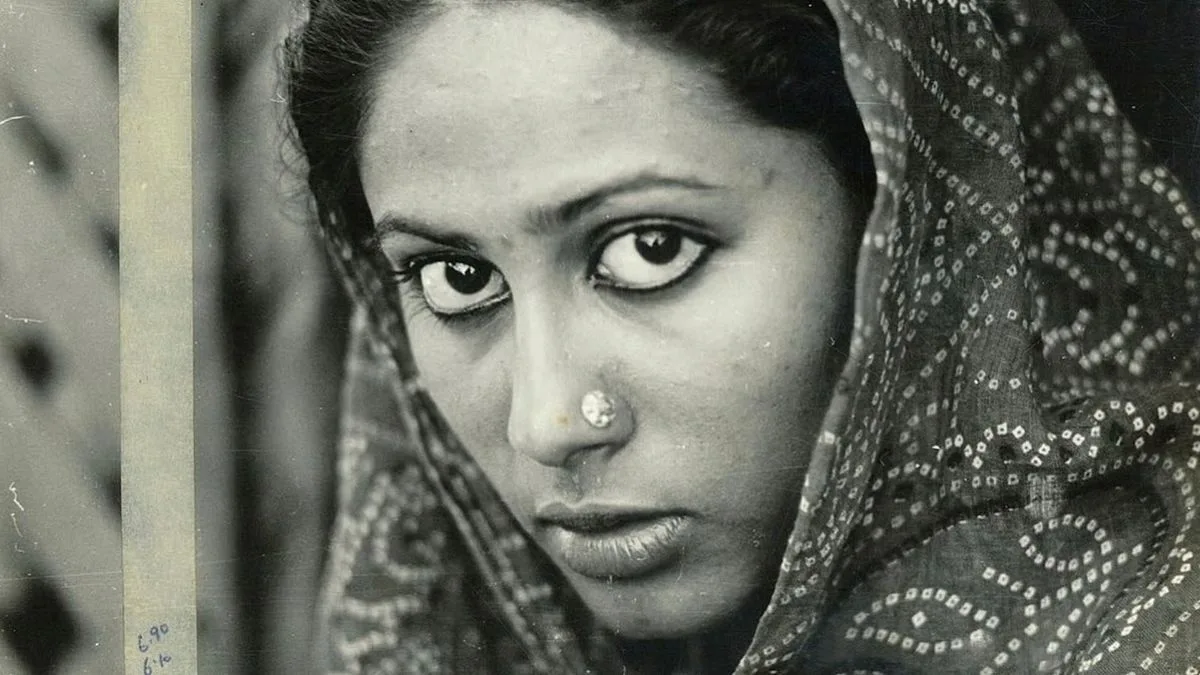
She died at 31. She made 80 films in 12 years. And in 2025, her face keeps appearing on mood boards, her interviews keep getting clipped, and her films keep being rediscovered by people who weren’t born when she died. That is not nostalgia. That is recognition. And, that is Smita Patil.
She played women India still hasn’t made peace with
In ‘Bhumika’ (1977), Smita Patil’s character leaves her husband, has an affair, leaves that man too, and still isn’t happy. The film doesn’t punish her. It doesn’t explain her. It just watches her.
Advertisement
In ‘Mirch Masala’ (1987), she plays a woman who refuses to sleep with a corrupt official. Her entire village turns against her. She still refuses.
In ‘Chakra’ (1981), Smita plays a slum woman trying to survive in Bombay. There is no hero who saves her.
These were not inspirational women. They were complicated, angry, exhausted, real. Bollywood in 2026 still struggles to put that woman on screen without softening her.
She never did the song-and-dance
Smita Patil appeared in mainstream films like ‘Namak Halaal’, ‘Shakti’. She could do commercial cinema. But she never let it swallow her.
Her parallel cinema work with Shyam Benegal, Govind Nihalani, Saeed Mirza was where she lived. These were films about drought, caste, labour, and domestic violence. Not metaphorical versions. Actual depictions.
Today, OTT platforms are hungry for exactly this kind of content. Dark, rooted, socially specific Indian stories. Smita Patil was making them in 1978 on a fraction of the budget, in films that played in single screens in small cities.
Her interviews sound like they were given last week
There is a 1983 Doordarshan interview where she says she is uncomfortable with stardom. She says she does not understand why her personal life is public property. She says the film industry treats women as decoration.
Then she was 28.
These are not radical statements in 2025. But in 1983, on national television, they were unusual. The interviewer looks visibly uncomfortable. She does not back down.
She was a Dalit rights activist before it was hashtag content
Smita Patil came from a politically active family. Her father, Shivajirao Patil, was a minister in Maharashtra. She was deeply aware of caste politics and spoke about it publicly.
Her film choices reflected this. ‘Chakra’, ‘Umbartha’, ‘Aakrosh’; these were films about structural injustice, not individual tragedy. The suffering in these films had a cause. A social cause.
In a film industry that still largely avoids caste as a subject, her filmography is a direct challenge. Every year, a new controversy erupts about caste representation in Bollywood. Every year, her films from 40 years ago look more relevant by comparison.
She had no filter and no PR
Smita Patil publicly discussed her relationship with Raj Babbar while he was still married. She had his child. She did not hide it. And, she did not apologise for it.
In the 1980s, that cost her. Films dried up. Producers kept their distance.
Today, her directness reads differently. The industry’s treatment of her reads differently too. She chose her life. The industry chose to punish her for it. The punishment is now the story, not the relationship.
Her physicality was political
She did not look like a Bollywood actress was supposed to look. Dark skin. Strong features. No attempt to conform to the light-skinned, soft-featured standard that dominated the industry then, and largely still does.
She won the National Award anyway. Twice. Once for ‘Bhumika’, once for ‘Chakra’.
The conversation about colourism in Indian cinema has become louder in the last five years. Every time it surfaces, Smita Patil gets cited. She is the example of what the industry could have become if it had followed her lead instead of sidelining her.
80 films. 12 years. No formula.
She started in 1974 with ‘Charandas Chor’. She died in December 1986. In between, she made art films, commercial films, Tamil films, Gujarati films, and everything in between, without repeating herself.
‘Nishaant’, ‘Manthan’, ‘Jait Re Jait’, ‘Arth’, ‘Sadma’, ‘Mandi’, each one is a different register, a different woman, a different world.
Most actors find a lane and stay in it. Smita Patil had no lane. She moved. That is incredibly rare and it becomes more visible, not less, as her filmography gets re-examined.
The archive is just opening up
Until recently, most of her films were hard to find. Bad prints. No streaming. No subtitles for non-Hindi speakers.
That is changing. ‘Mirch Masala’ is on YouTube. ‘Umbartha’ has been restored. Film scholars and critics are writing about her in English, making her accessible to audiences outside Maharashtra and outside India.
The generation discovering her now is not the generation that watched her in cinemas. They are coming to her fresh, with no nostalgia, and finding her extraordinary. That is the real test of relevance.
What she leaves behind
No acting school claims her as an influence officially. No award is named after her. The industry she worked in has not built a mythology around her the way it has around Guru Dutt or Raj Kapoor.
That absence is also a kind of statement.
She was too inconvenient to celebrate properly. Too political, too honest, too unwilling to perform gratitude. The industry moved on. But her films didn’t move anywhere. They stayed exactly where she left them, waiting for an audience ready to take them seriously.
That audience is here now.